
Scientists of the Institute of Functional Materials Chemistry (IFMC) of the State Scientific Institution "Institute for Single Crystals" of NAS of Ukraine visited the Faculty of Biology of V. N. Karazin Kharkiv National University as part of the establishment of the Pharmaceutical Cluster.
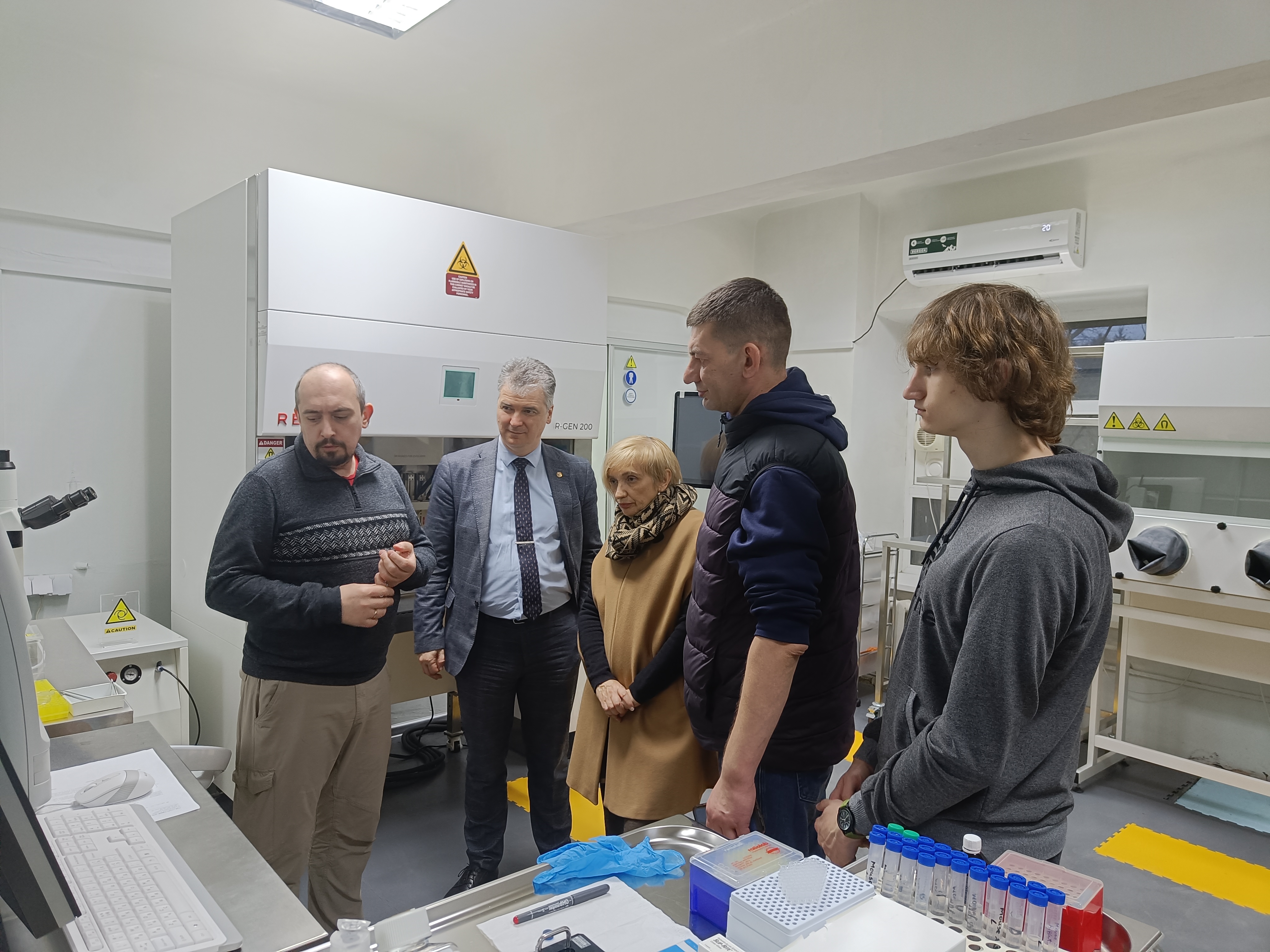
The Head of the Cluster Coordination Council, First Deputy Director General of the SSI ISC, Director of the IFMC, Academician of the National Academy of Sciences of Ukraine Valentyn Chebanov, Deputy Director of the Institute of Functional Materials Chemistry Olesia Kulyk, Prof. Victoria Lipson, and PhD Oleksiy Solodyankin got acquainted with the work of a new educational and research facility - the BioMed Research Laboratory organised by the Department of Molecular Genetics Research of V. N. Karazin Kharkiv National University.
The head of the laboratory, associate professor of the Department of Biochemistry Yuriy Kot, presented the capabilities of one of the best-equipped laboratories in Ukraine. At the laboratory, undergraduate and postgraduate students master practical skills in molecular biology, molecular genetic diagnostics, forensics, and related fields.
Of particular interest was the bioprinter for creating artificial tissues — unique in Eastern Europe and one of only 17 in the world.
During the meeting, the parties discussed opportunities for joint research, sharing of experience, and development of sustainable partnerships. Particular attention was paid to the potential for cooperation within the Pharmaceutical Cluster, the founders of which include both the State Scientific Institution "Institute for Single Crystals" and V. N. Karazin Kharkiv National University. Head of the Cluster Coordination Council Valentyn Chebanov emphasized:
“Creating a pharmaceutical cluster is not enough. The main thing is to establish efficient cooperation between participants, so that partnership gains momentum and provides new opportunities for result-oriented scientific work.”
Cooperation between high-tech scientific institutions paves the way for the development of modern pharmaceutical products, forms a powerful innovation system, and deepens scientific cooperation at all stages — from fundamental research to prototype devices.